Environment
Our Approach
The TOTO Group is committed to contributing to the environment through plumbing products by continuing to implement such initiatives as water-saving and energy-saving measures. In addition to introducing energy conservation to manufacturing processes at business sites and using renewable energy, we are committed to being ecofriendly throughout the product life cycle, including during product use, by creating products with high environmental performance. We have also defined sustainable products as those that bring "cleanliness and comfort; wellness" and contribute to the environment. By popularizing these products around the world, we will contribute to realizing an enriched, comfortable, and environmentally friendly society.
Under our material issue of “Environment,” we will contribute to resolving various issues, including those identified by Goal 6 of the SDGs—Clean water and sanitation.
Protect Our Limited Water Resources and Connect with the Future
The surface of the earth is mostly covered in water, but in actuality only 0.01% of that is fresh water, such as rivers and lakes, that can actually be used for the livelihood of people.*1 As a supplier of bathroom and kitchen plumbing products, we believe we have the duty to respond to the issue of depletion of water resources, as it significantly affects the daily lives of everyone.
Avoided Emissions of Water During Product Use
TOTO manages its targets as “Avoided emissions of water during product use,” defined as the reduction effect over the product use period compared with the case where products from 2005 continue to be used. In fiscal 2025, our actual avoided emissions of water during product use amounted to 0.90 billion m3.
By promoting the global use of products with high watersaving performance while ensuring user comfort, TOTO aims to contribute to further avoided emissions of water during product use. It is said that the amount of water used for living by individuals across different countries and regions ranges from approximately 20 to 500 liters each day.*2 Assuming that average daily water use per person is 282 liters, the same as in Japan,*1 our target for avoided emissions of water during product use—1.3 billion m3 by fiscal 2030—is equivalent to the annual water usage of approximately 13 million people.
Evolution of Water-Saving Performance of Toilets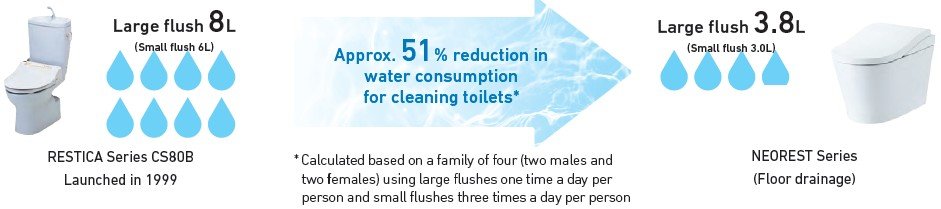
We have been working to reduce the amount of water needed to flush toilets and to expel and transport waste while ensuring toilets remain pleasant to use. As such, we are now able to provide customers with a toilet that uses only 3.8L of water per large flush. In addition, we are striving to improve the water-conservation performance of our showers and other water faucets.
*1 Source: Current State of Water Resources in Japan (2025), Ministry of Land, Infrastructure, Transport and Tourism
*2 Source: Food and Agriculture Organization of the United Nations’ AQUASTAT 2022
Carbon Neutrality Initiatives
While recognizing the impact of climate change as a critical risk, we also see the growing demand for sustainable products that balance cleanliness, comfort, wellness, and the environment as an opportunity. Looking ahead to 2050, we are working to reduce greenhouse gas emissions in line with the SBT*1 1.5ºC level, with a focus on manufacturing, sales, and product use. Regarding emissions from our business sites (Scope 1 & 2), we are implementing reduction plans that utilize new technologies, such as introducing renewable energy and using green hydrogen*2 in sanitary ware manufacturing. Also, since many of our products remain in use for long periods, approximately 10 to 20 years, and product use (Scope 3, Category 11) accounts for more than 90% of product life cycle CO2 emissions, we will reduce these emissions by promoting the global adoption of energy-saving and water-saving products, contributing to the realization of a carbon-neutral and sustainable society.
*1 Science-based greenhouse gas emission reduction targets for companies that meet the level required by the Paris Agreement
*2 Hydrogen produced by electrolyzing water using renewable energy electricity
Evolution of Life Cycle Assessment of Products and Expanded Acquisition of EPDs
To meet society’s expectations that we contribute to carbon neutrality and provide highly transparent environmental data disclosures, we use life cycle assessment (LCA), an ISO-compliant environmental impact assessment method, and are advancing our understanding of environmental impacts throughout the entire value chain. To disclose the results of our environmental impact assessments following third-party verification, we have been obtaining Environmental Product Declarations (EPDs) for representative products including floor-standing toilets, wall-hung toilets, mixer faucets, WASHLET, and WASHLET-integrated toilets. Through these LCA activities, we have accumulated experience and know-how in collecting environmental data regarding a wide range of raw materials and components, which enables us to conduct LCAs for a diverse range of products. As legislation requiring LCA calculations and disclosures for buildings progresses in various countries and regions, we anticipate that demand for data disclosure will increase even further. Going forward, we will continue to use LCA methods to visualize the environmental impact of a wide range of products, further advancing our efforts to reduce environmental impact in each stage, from raw material procurement to manufacturing, use, and disposal, while also responding to demands from markets for environmental data disclosure.
Representative Products with EPDs
Sustainable Procurement with Consideration for Biodiversity
We established Sustainable Raw Material Procurement Standards and regard the procurement of earth and stone raw materials and recycled wood materials, from which our staple products are made, as a critical issue to consider. For earth and stone raw materials, we conduct a questionnaire survey or an interview at all mines subject to management at least once every three years, and all surveyed mines have met the required standards. For recycled wood materials, the usage rate of legal and recycled materials for products is used as an indicator and we verify the actual values.
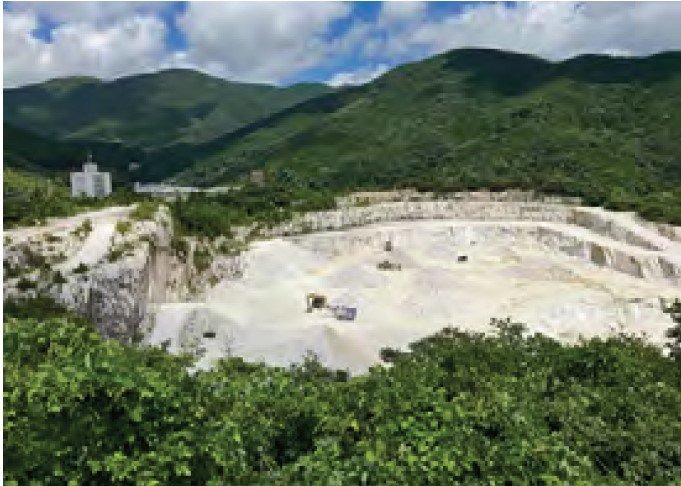
- Achievement Rate of Compliance Item Standards of Mines Fiscal 2025 results 100%
- Usage Rate of Legal and Recycled Wood Materials Used in Products Fiscal 2025 results 100%
Aim for Sustainable Development Together with Local Communities
To develop sustainable local communities and a society that uses water effectively into the future, not only are the business activities of corporations important but the role of civic activities is also essential. Accordingly, the TOTO Group established the TOTO Water Environment Fund in 2005 and continues to support groups that are engaging in water-related environmental activities. We are supporting the activities of citizens and organizations that work to secure water sources and water quality, protect ecosystems, and plant trees through the fund. At the same time, our employees participate voluntarily in such activities. Additionally, TOTO was certified as a Water Cycle ACTIVE company under the Water Cycle Company Registration and Certification System of the Cabinet Secretariat’s Headquarters for Water Cycle Policy.
・Supporting Ongoing, Community-Based Activities
In many countries and regions around the world, people are losing their lives due to water scarcity and poor sanitation. These areas face numerous challenges, including environmental conservation, poverty, education, and gender equality. Addressing these challenges requires more than just the one-time provision of water-related equipment or capital. It is essential to establish sustainable systems for the maintenance and management of water-related equipment.
Children washing their hands at a handwashing station(go share)
With this in mind, we must convey the importance of sanitary living environments while providing ongoing assistance for local communities. The TOTO Water Environment Fund aims to support groups engaged in these activities, with an eye toward fostering sustainable development.
・Working Together to Solve Issues as a Member of the Community
The TOTO Water Environment Fund also encourages Group employees to volunteer in the activities of the organizations receiving its grants. Even after the grant period ends, the exchange of information and participation in volunteer activities continue, fostering ongoing relationships with the grant recipients and the local communities, and expanding the scope of these activities each year.
Beach cleaning in Oita Prefecture (Asia Pacific University, Environmental Community Organization for Sustainability)
お気に入りに保存しました