Information Disclosure Based on the TNFD Recommendations
Our Approach
Our lives and livelihood are supported in various ways by the benefits that natural capital provides. If we are to continue to enjoy the blessings of natural capital in the future, all of us—every member of society—will need to work together to protect natural capital and use it sustainably. Business enterprises have an important role to play here as well in their capacity as corporate citizens. The TOTO Group has placed environmental issues, which is a common global challenge, as an issue to be resolved through business, and has established the Global Environmental Policy to contribute to the creation of a sustainable society. By conducting business activities in accordance with this Policy, we will conserve and sustainably use natural capital and refrain from engaging in activities that may lead to the extinction of endangered species.
[ Global Environmental Policy ]
4.We promote the conservation and sustainable use of biodiversity.
- The destruction of nature resulting from business activities is avoided and biodiversity is preserved.
- We procure raw materials in each country in such a way that we do not harm the local environment and biodiversity.
- Collaborating and cooperating with stakeholders, we contribute to building society that cultivates biodiversity.
・Participation in the Keidanren Initiative for Biodiversity Conservation
The TOTO Group agrees with the Keidanren Declaration on Biodiversity (revised version), which expresses the commitment to biodiversity conservation, and participates in the Keidanren Initiative for Biodiversity Conservation.
Disclosure of Information Based on the TNFD Recommendations
In July 2026, the TOTO Group registered as a TNFD Adopter, endorsing the philosophy of the Taskforce on Nature-related Financial Disclosures (TNFD). Along with this registration, we disclose information on our initiatives toward the realization of natural capital conservation
General Requirements
General Requirements | Status of Disclosures |
The application of materiality | We apply a double materiality approach that encompasses both our dependencies and impacts on nature. |
Scope of disclosure | Among the business segments of the TOTO Group, we have designated the Housing Equipment Business—which accounts for approximately 90% of our total consolidated sales and is considered to have a high impact on natural capital—as the subject of our assessment and disclosure. For the assessment, we utilize the ENCORE tool while also conducting fact-finding surveys, particularly on the procurement of raw materials for sanitary ware. Within our value chain, we define 'Upstream' as procurement, 'Direct' as manufacturing, and 'Downstream' as logistics and sales. |
Location of nature-related issues | We identified priority locations focusing on our housing equipment business production sites, raw material sources, as well as water-stressed areas and clay/stone mines with a high dependency and impact on nature related to sanitary ware production. |
Integration with other sustainability-related disclosures | This disclosure is focused solely on reporting aligned with the TNFD recommendations. Going forward, we plan to verify the alignment between climate change and natural capital, and we will consider integrating this with our climate-related disclosures. |
Time horizons | The time horizons are defined as follows: Short term: Fiscal year Medium term: FY2030 Long term: FY2050 |
Engagement with Indigenous Peoples, Local Communities and affected stakeholders in an organisation's identification and assessment of nature-related issues | With the globalization of supply chains, the risks faced by companies are becoming increasingly complex. The TOTO Group recognizes that it is essential to practice ethical, socially, and environmentally effective actions at a high standard, not only within our own operations but also across our entire supply chain. Together with our suppliers, we will strive to improve sustainability and minimize risks across the supply chain, while addressing social and global environmental issues throughout the entire supply chain, aiming to realize a sustainable society. |
Governance
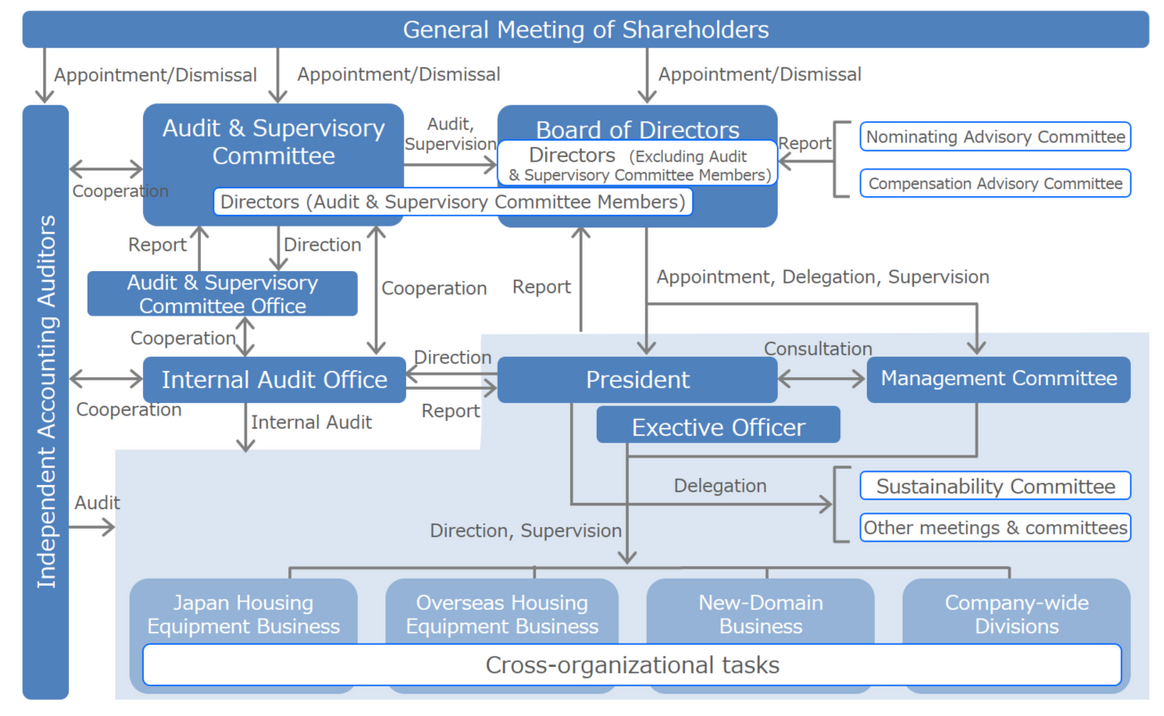
We recognize the impact of natural capital loss as a material business risk. The Sustainability Committee, chaired by the President and CEO, meets three times a year to deliberate and execute on sustainability-related issues, including natural capital, while the Board of Directors oversees these activities.
Sustainability Promotion Structure
In 2004, we established the "CSR Committee" and a dedicated CSR department to launch our CSR activities. In fiscal 2023, we transitioned this system to the "Sustainability Committee." Chaired by the President and Chief Executive Officer, the Sustainability Committee meets three times a year to address sustainability management from a holistic perspective across three key areas: "Environment," "Society," and "Governance."
The Sustainability Committee deliberates on sustainability issues—including natural capital—and materiality, and formulates activity plans that identify priority regions. Concurrently, each responsible subcommittee develops its own promotion plans and rolls them out to relevant departments and group companies both in Japan and overseas, driving cross-functional initiatives.
Separate from the Sustainability Committee, the Board of Directors meets once a year to deliberate on sustainability management, including nature-related issues.
Human Rights Policy and Engagement Activities
The TOTO Group wants to be an entity that constantly assumes a leading role in the realization of a sustainable society by creating added value, which is useful for society, and employment, as well as by autonomous and responsible actions through fair and free competition. To realize that, all people working for the TOTO Group strive to play an active role with a strong sense of ethics based on the concepts indicated in the corporate motto and philosophy, and to fulfill their social responsibilities.
Deploying its business activities that respect the human rights of all people in each country and region and contributing to the development of such activities are stipulated in the Charter of TOTO Group Corporate Behavior, which is the basic stance of behavior of all people working for the TOTO Group, and the Human Rights Policy stipulates the policy to fulfill responsibility to respect human rights as a company based on the Charter of TOTO Group Corporate Behavior.
Based on the United Nations Guiding Principles on Business and Human Rights, the TOTO Group supports and respects international norms of human rights, such as the International Bill of Human Rights, ILO Declaration on Fundamental Principles and Rights at Work, Children’s Rights and Business Principles, and similar declarations and standards.
The TOTO Group is committed to procurement that respects biodiversity. Across our entire supply chain, we work to ensure that procurement activities account for human rights, labor, and compliance, as well as impacts on local and indigenous communities, and the environment and ecosystems of production areas.
Furthermore, we have established the "Sustainable Raw Materials Procurement Standards," identifying raw clay/mineral materials and wood-based materials—which are key components of our core products—as high-priority items that require careful consideration. Regarding raw clay and minerals, we conduct hearings at all mines at least once every three years, and all mines have successfully met the standards required by the TOTO Group. For wood-based materials, we track and verify performance by using the utilization rates of legally sourced wood and recycled wood in our products as key indicators.
If the results of the hearings on raw clay and minerals reveal any failure to meet our Sustainable Raw Materials Procurement Standards, the issue is discussed by the Sustainability Committee. If the impact is determined to be particularly significant, it is reported to the Board of Directors.
Strategy
Process for Prioritizing Dependencies, Impacts, Risks, and Opportunities
The TOTO Group has identified environmental materiality issues as: "Protecting finite water resources and connecting them to the future," "Biodiversity-conscious sustainable procurement," "Avoiding environmental risks," "Aiming for sustainable development together with local communities," and "Initiatives toward carbon neutrality." In addition, looking toward 2030, we have identified our dependencies and impacts on natural capital, as well as risks and opportunities, within our direct operations and across our entire value chain, in accordance with the "LEAP approach"—the framework recommended by the TNFD.
To identify these dependencies, impacts, risks, and opportunities, we defined the TOTO business value chain into three stages: "Procurement," "Manufacturing," and "Logistics and Sales," and conducted our evaluation. For the identification of dependencies and impacts, we first performed screening using secondary data (industry averages from the ENCORE tool). Following this, we conducted on-site surveys at our own business sites and the raw clay and mineral mines for sanitary ware to ensure the evaluation reflects the actual local conditions.
Assessing the Relationship Between Natural Capital, Biodiversity, and Business
The TOTO Group is working to visualize the relationship between its business activities, natural capital, and biodiversity, with the aim of integrating these insights into our sustainability management.
Based on the "LEAP approach" recommended by the Taskforce on Nature-related Financial Disclosures (TNFD), we are currently evaluating our dependencies and impacts on natural capital, as well as the risks and opportunities arising from them.
Focusing on the production of sanitary ware, which represents the TOTO Group's core business, we have developed a heatmap using the ENCORE tool to clarify our relationship with natural capital.
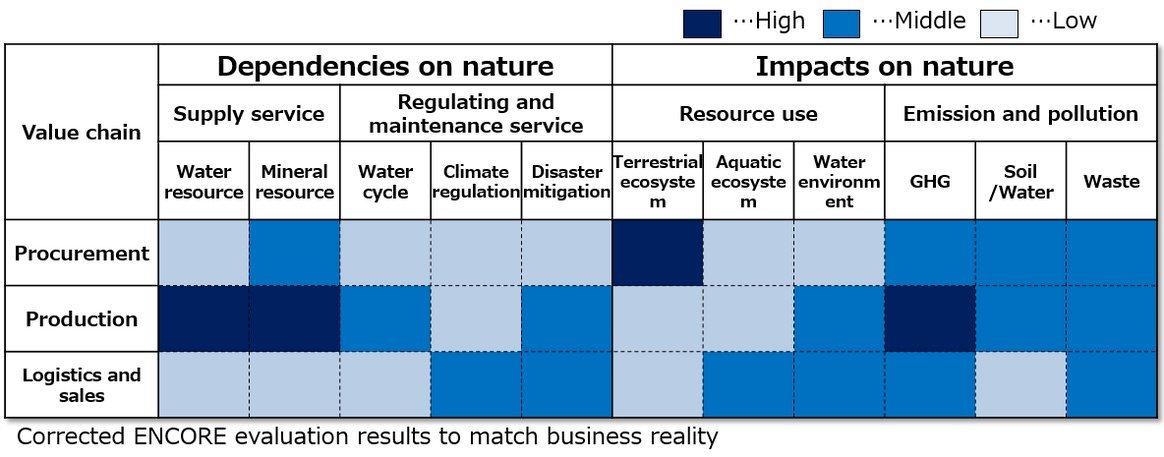
Through our assessment of dependencies and impacts, we revealed that the TOTO Group's business has significant dependencies on water and mineral resources, as well as a high impact through GHG emissions. Furthermore, within our value chain, we identified that our procurement of raw clay and mineral materials—the main ingredients for sanitary ware—has a substantial impact on terrestrial ecosystems.
Initiatives in the heat map items with high dependence and impact on natural capital are as follows.
- Dependence on water resources: In the production of sanitary ware, water is mixed with raw clay and mineral materials to create slurry for molding sanitary ware. We are working to conserve and recycle this water in the production process and to use it efficiently.
- Dependence on mineral resources / Impact on terrestrial ecosystems: With regard to soil and stone raw materials, we are working on sustainable procurement together with our suppliers to minimize our dependence on and impact on natural capital as much as possible.
- Impact of GHG emissions: We are promoting reductions in GHG emissions based on the SBT 1.5℃ reduction target.
Identification of Priority Locations
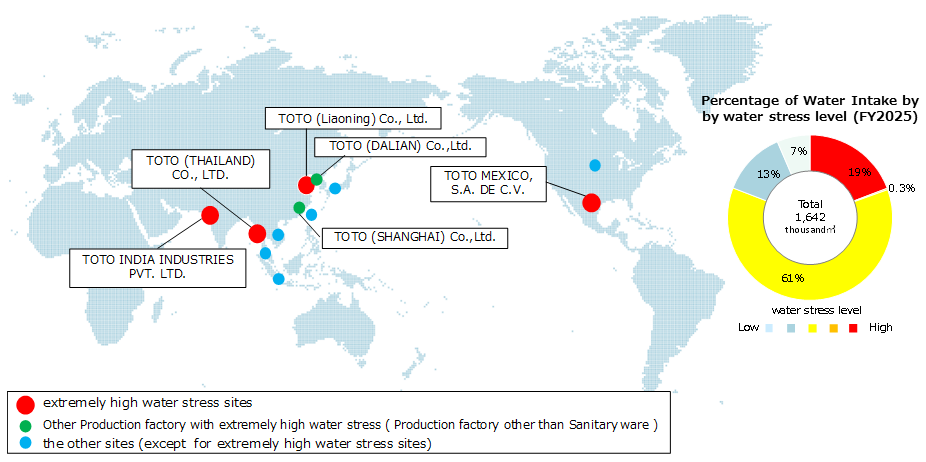
The TOTO Group evaluates water-related risks for sustainable business activities.
We conduct risk assessments for floods and water pollution and specifically make efforts to understand the detailed status of water stress (the degree of tightness between water supply and demand) because we believe that it has a strong impact on business continuity.
As a large quantity of water is used in the production processes, we strive to capture water stress of all the production site regions to lead to effective responses. The evaluation method complies with the GRI (Global Reporting Initiative). We assess the water stress and water depletion of each production site regions using Aqueduct, which was developed by the World Resources Institute and the Water Risk Filter by the World Wildlife Fund (WWF), to identify those under water stress.
Among our sanitary ware manufacturing sites, which have particularly high dependencies on water resources within our overall business, we have identified four sites across four countries—Mexico, Mainland China, India, and Thailand—evaluated as facing "Extremely High" water stress, as our priority locations.
Overview of Scenario Analysis
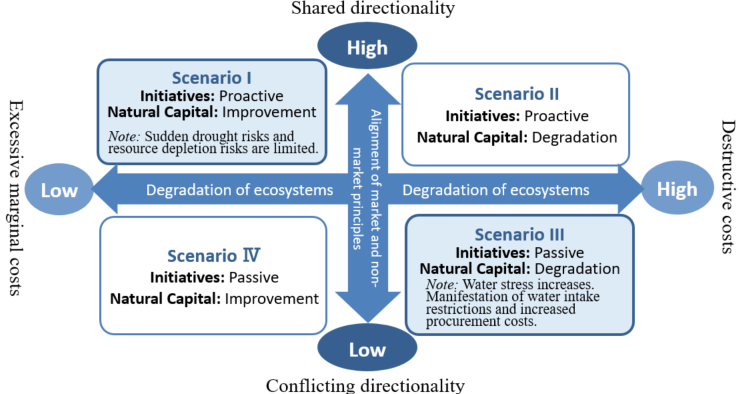
To identify nature-related risks and opportunities within the TOTO Group, we referenced the TNFD guidance. Utilizing a matrix with two axes and four quadrants—"Ecosystem Degradation" and "Alignment of Market and Non-market Channels"—we assumed two social conditions for the year 2030: "Scenario I: A world in which initiatives for natural capital progress" and "Scenario III: A world in which initiatives for natural capital do not progress, leading to advanced ecosystem degradation." Based on these, we estimated the financial and business impacts of these risks and opportunities.
Assumptions for Social Conditions in 2030
<Social Conditions under Scenario I> Policies and regulations for the sustainable use of water resources, raw clay, and mineral materials are tightened, leading to more advanced environmental standards such as water resource management. Companies are increasingly required to show consideration for ecosystems, including reducing water withdrawal and mitigating environmental impacts in resource procurement regions. Furthermore, as the management of water and mineral resources progresses across the entire supply chain, excessive water withdrawal and unregulated mining are suppressed. As a result, the progression of water stress, water quality degradation, and resource depletion risks is kept in check to some extent, and the impacts of sudden water withdrawal restrictions are expected to remain limited.
<Social Conditions under Scenario III> The tightening of policies and regulations for conserving water and mineral resources remains limited, and efforts to address the environmental impacts of water withdrawal and mining do not progress sufficiently. Companies’ initiatives for water conservation and sustainable raw material procurement remain limited, and the inadequate management across the entire supply chain persists. As a result, the overexploitation of water resources and the degradation of water quality progress, leading to heightened water stress and actual occurrences of water withdrawal restrictions. At the same time, risks such as environmental degradation in procurement regions, deterioration of raw material quality, and procurement instability increase. Consequently, it is assumed that this may impact operations and lead to rising raw material procurement costs.
Risk and Impact Management
Identification of Risks and Opportunities
We assumed social conditions as of 2030 to analyze the risks and opportunities presented to the TOTO Group, and examined our medium- to long-term responses to them. The time horizons for this analysis are defined as follows:
Time Horizons
Short-term: Single fiscal year (aligned with the accounting period)
Medium-term: Through fiscal year 2030 (aligned with the TOTO WILL2030 medium- to long-term management plan)
Long-term: Around 2050 (aligned with our 2050 carbon neutrality goal, the ultimate target year for achieving decarbonization)
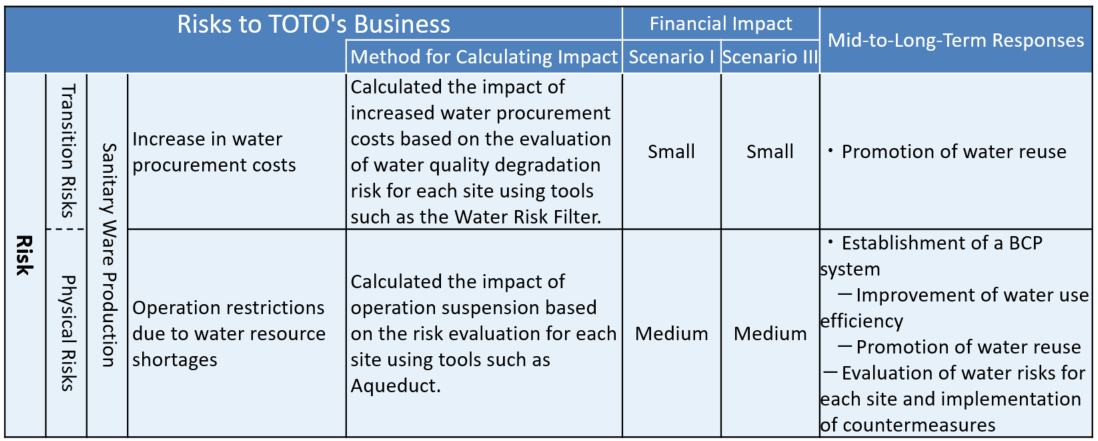
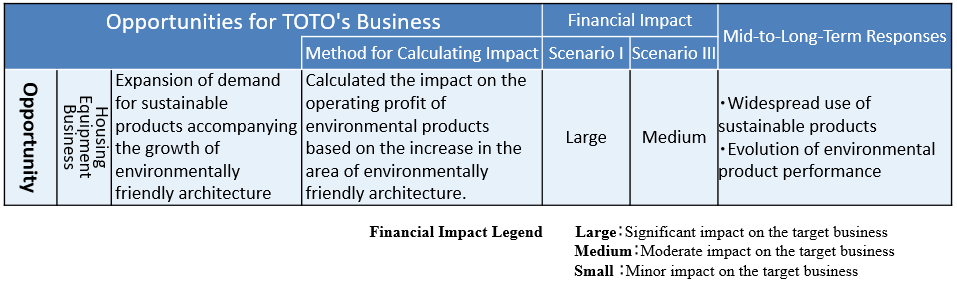
In particular, regarding water resources, which we identified as a high-dependency area for our business activities, we prioritize the mitigation of our dependency on water and are working to reduce water withdrawal by promoting water reuse. As a transition plan for the sanitary ware manufacturing process—where our dependency on water resources is exceptionally high—we have set water reuse rate targets for fiscal year 2030 at 50% or higher for all sanitary ware manufacturing sites, and 65% or higher for sites located in water-stressed areas. Through these measures, we are actively working to reduce both our dependency on water resources and our associated water risks.
Risk Management
To assess risks, we utilized tools such as Aqueduct and ENCORE to identify risks across the entire TOTO Group, including our value chain. Regarding dependencies and impacts, we manage them through the creation of a heat map.
For risk management, we have established the "TOTO Group Risk Management Policy" and are actively engaged in risk management initiatives. Risks related to our business, including nature-related issues, are evaluated by the Risk Management Committee. Risks that could potentially have a significant impact on our business or society are extracted and managed as "Major Risks," which are then reported to the Board of Directors. In addition, each business division and site manages environment-related risks under our Environmental Management System.
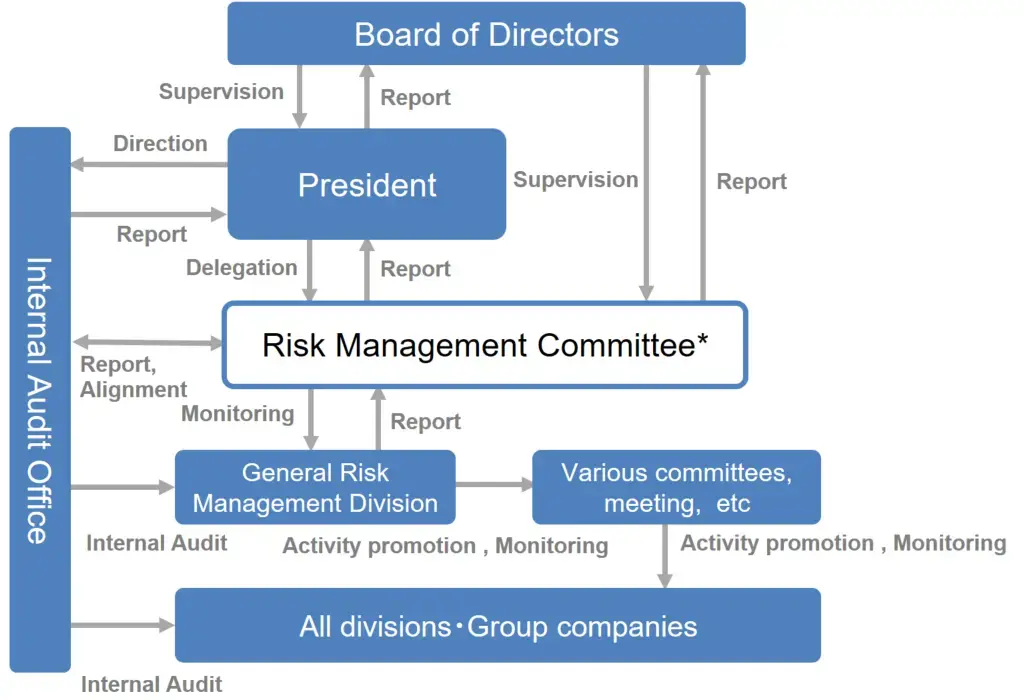
* Committee chairman : Director, Senior Managing Executive Officer, Chief Financial Officer
Committee Vice chair: Director in charge of general affairs
Committee members : Each division manager
Each major risk is mapped out on a matrix evaluating degree of impact and frequency of occurrence from the viewpoints of damage to the brand, impact on personnel and financial consequences along an assumption scenario,and monitored by the Risk Management Committee, and risk mitigation activities are promoted throughout the entire Group
The list of Major Risks, including those related to the TNFD, is as follows:
Management risk | Intensifying competition to recruit human resources |
Disruptions to the Procurement of Raw Materials, etc. due to Geopolitical Risks | |
| Changes in market environment | |
| Defect in products | |
| Filing of lawsuits | |
| Rapid technology innovation | |
Political, economic, social risk | Risk of Geopolitical Conflicts and Deteriorating Public Security |
| Climate change | |
| Rapid declines in product prices due to intensifying competition from rival companies | |
| Compliance violations including within the supply chain | |
| Spread of infectious disease | |
| Environmental regulations | |
| Risk of financial damage caused by rumors | |
| Intellectual property infringement | |
| Risk of disaster | Large-scale disasters |
| Occupational safety and health | |
IT-related risk | Leakage of Confidential and Personal Information |
Occurrence of disruptions to information systems |
Metrics and Targets
Under our "TOTO WILL2030" shared value creation strategy, we have set our vision for 2050 to achieve a sustainable society and realize carbon neutrality.
As milestones for realizing this vision, we have established our targets for 2030. Regarding greenhouse gas (GHG) emissions, we have obtained validation for our emissions reduction targets from the Science Based Targets (SBT) initiative, which are aligned with climate science, and are actively driving initiatives to achieve them. To demonstrate our commitment to reducing GHG emissions, we disclose detailed information regarding our targets and progress toward achieving carbon neutrality by 2050 in our "Disclosure Based on TCFD Recommendations”
Based on the identified and assessed risks and opportunities related to climate change and nature, our Group discloses information and continuously monitors indicators aligned with the TNFD global core metrics to track and manage our response to these issues.
Metric ID | Driver of Nature Change | Indicator | Metric | FY2025 Results |
Climate change | GHG Emissions | GHG Emissions(Scope1-3) | Financial and Non-Financial Data | |
| C2.1 | Pollution / Pollution removal | Wastewater discharge | amount of water discharges | Financial and Non-Financial Data |
Concentration by Location | Regulatory items for each site data | |||
| C2.2 | Waste generation and disposal | amount of waste processed | Financial and Non-Financial Data | |
| C2.4 | Total Non-GHG Air Pollutants | Non-GHG Air Pollutants by Type (Tons) Dust emissions/SOx emissions/NOx emissions/VOC emissions | Financial and Non-Financial Data | |
| C3.0 | Resource use / replenishment | Water withdrawal and consumption from areas of water scarcity | Water withdrawal from areas of water scarcity | Water Withdrawal by Water Stress Level |
| A2.0 | Driver of nature change: Pollution / Pollution removal | Wastewater treated, reused / recycled, or avoided | Water recycling rate | Financial and Non-Financial Data |
| A2.1 | Minimisation, reuse, and recycling of waste | waste recycling amount | Financial and Non-Financial Data | |
| A2.3 | Light and noise pollution | Noise Regulation Compliance by Location | Regulatory items for each site data | |
| A3.0 | Driver of nature change: Resource use and replenishment | Total amount of water consumption and Total amount of water withdrawals | Total amount of water consumption Total amount of water withdrawals | Financial and Non-Financial Data |
| A3.2 | Water reduced, reused / recycled | Water recycling rate/Amount of recycled water |
Regarding water resources, which we identified as a high-dependency area for our business activities, we prioritize the mitigation of our dependency on water and are working to reduce water withdrawal by promoting water reuse. As a transition plan for the sanitary ware manufacturing process—where our dependency on water resources is exceptionally high—we have set water reuse rate targets for fiscal year 2030 at 50% or higher for all sanitary ware manufacturing sites, and 65% or higher for sites located in water-stressed areas. Through these measures, we are actively working to reduce both our dependency on water resources and our associated water risks.
Furthermore, with initiatives like WILL2030, targets have been set for nature-related issues, promoting efforts toward sustainable management.Please refer to the Financial and Non-Financial Data for details on each indicator and target.
Introduction of the Social value, Environmental value index in Directors’ Compensation
TOTO, which engages in sustainability management, has set the percentage of sustainable products in the Shared Value Creation Strategy TOTO WILL2030 as a social and environmental value indicator for the Bonus Based on Multi-Year Performance since fiscal 2022.
We decided to set the six items of the social and environmental value upheld in the WILL2030 long-term goals as indicators for the Bonus Based on Multi-Year Performance since fiscal 2023 to further promote the sharing of value with stakeholders and to realize a rich and comfortable society in the future while giving more consideration to the global environment.
Social and Environmental Value Indicators
・Percentage of sustainable products
・Contribution to the reduction of water consumption during product use
・CO2 emissions from business sites
・Customer satisfaction in after-sales service
・Showroom satisfaction (Japan)
・Employee satisfaction (Japan)
Changes in water use
Water withdrawals
| Source | Unit | FY2021 | FY2022 | FY2023 | FY2024 | FY2025 |
| Fresh surface water | thousand m3 | _ | _ | _ | _ | _ |
| Groundwater | thousand m3 | 463 | 426 | 419 | 354 | 328 |
| Seawater | thousand m3 | _ | _ | _ | _ | _ |
| Produced/Entrained water | thousand m3 | _ | _ | _ | _ | _ |
| Third party sources | thousand m3 | 2,212 | 1,981 | 1,598 | 1,431 | 1,314 |
| Water withdrawals – total volumes | thousand m3 | 2,675 | 2,407 | 2,017 | 1,785 | 1,642 |
| (per unit of sales) | m3/ millions yen | 4.15 | 3.43 | 2.87 | 2.46 | 2.23 |
Water consumption
| Index | Unit | FY2021 | FY2022 | FY2023 | FY2024 | FY2025 |
| Water consumption – total volumes* | thousand m3 | 825 | 694 | 566 | 422 | 317 |
Water recycled/reused
| Index | Unit | FY2021 | FY2022 | FY2023 | FY2024 | FY2025 |
| Amount of recycled Water | thousand m3 | 2,163 | 2,008 | 1,737 | 1,765 | 1,494 |
| Water recycling rate | % | 44.7 | 45.5 | 46.3 | 49.7 | 47.6 |
Water discharges
| Destination | Unit | FY2021 | FY2022 | FY2023 | FY2024 | FY2025 |
| Fresh surface water* | thousand m3 | 702 | 668 | 609 | 596 | 531 |
| Groundwater | thousand m3 | _ | _ | _ | _ | _ |
| Seawater* | thousand m3 | 33 | 40 | 39 | 49 | 57 |
| Third-party destinations* | thousand m3 | 1,115 | 1,004 | 803 | 718 | 737 |
| Water discharges – total volume* | thousand m3 | 1,850 | 1,713 | 1,451 | 1,363 | 1,325 |
| ( per unit of sales )* | m3/ millions yen | 2.87 | 2.44 | 2.07 | 1.88 | 1.80 |
* In 2025, we retrospectively revised the figures for wastewater discharge and water consumption following a review of the calculation methodologies applied in prior periods.
For details on our water usage reduction initiatives, please click here.
お気に入りに保存しました